
City of London’s ‘retrofit first’ policy comes into force

A proposal by the City of London to encourage reuse of existing buildings has become policy after being approved by the Corporation’s Planning and Transportation Committee.
The new Planning for Sustainability Supplementary Planning Document (SPD), provides guidance on how developers should approach the City Corporation’s sustainability policies in their planning applications.
Last year it was reported that eight more London boroughs are poised to follow suit.
These include Camden, through its Local Plan approved in April this year which prioritises retrofitting existing buildings over demolition;
Westminster is introducing a similar policy in its draft Local Plan review:

It has been reported that Ealing, Enfield, Merton, Kingston, Richmond and Tower Hamlets are bringing forward policy or guidance adopting a ‘retrofit first’ approach and that several other boroughs are preparing supplementary planning guidance on it.
In its new Local Plan, the Royal Borough of Kensington and Chelsea has gone one step further to introduce a policy presumption against the redevelopment of social housing estates:
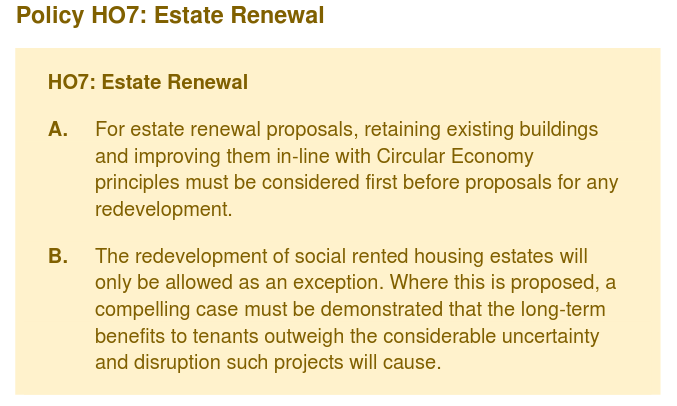
It is becoming clear that there is an increasing awareness of the huge social, environmental and financial costs of estate redevelopment.
A 2013 study by architects Gensler, showed that refurbishment of the Heygate estate in Southwark could have saved 40,000 Tonnes of CO2 while costing the same as the Council paid to decant the estate:

The Architects Journal is running a Retrofirst Campaign to promote retrofit over demolition and rebuild, supported by hundreds of architecture practices, organisations and individuals.
The Mayor and GLA appear to be taking note. In a ‘Retrofit vs Rebuild’ report by its Planning and Regeneration Committee, it stated that lessons should be learnt from the City of London on its retrofit first approach. The report said "A trend towards discouraging demolition could positively impact how we manage the quality of our historic housing estates going forward. This, in turn, could positively impact the capacity for communities to remain in their homes and to protect beloved historic community buildings".
We argue in our Alternative Estate Regeneration Guidance that there should be a basic policy presumption against the demolition of social housing estates and we will be encouraging the Mayor to adopt such an approach in the forthcoming London Plan Review. WATCH THIS SPACE!